
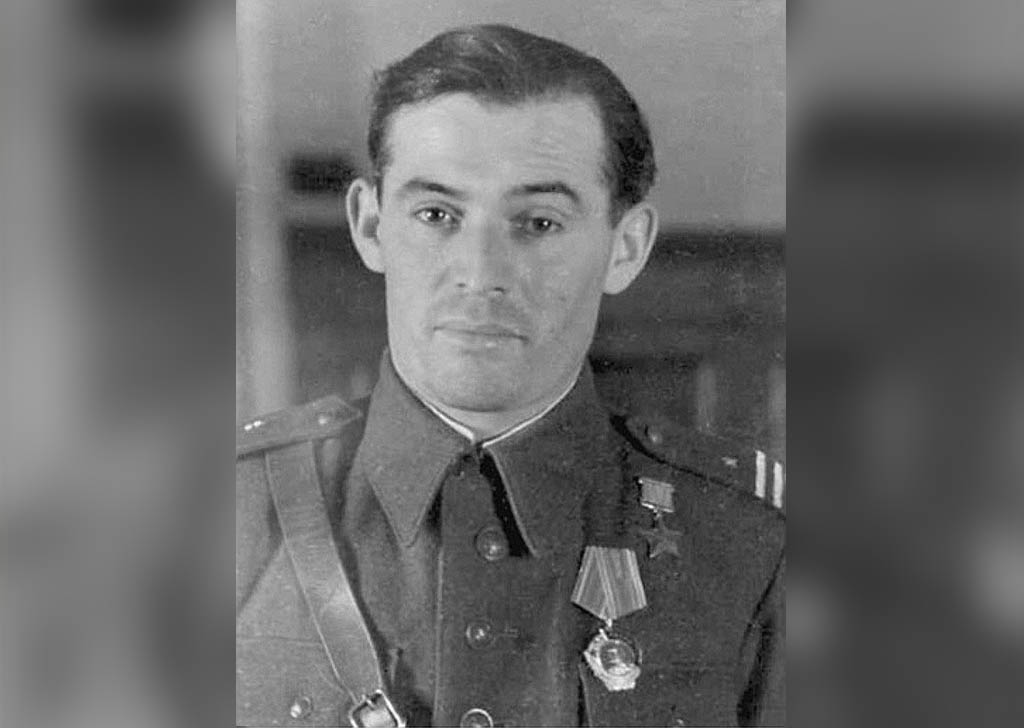
Juliusz Samsonovich Hibner (also Gibner and Hubner, patronymic sometimes Shimonovich) – birth name – David Schwartz (October 11, 1912, Grzymaluv, Kingdom of Galicia and Lodomeria, Austria-Hungary (now Grymaiv, Ternopil region, Ukraine)— November 13, 1994, Warsaw, Poland). Polish military leader and nuclear physicist, Major General, participant in World War II, Deputy commander for political and educational work of the 1st Infantry Regiment of the 1st Polish Division named after Tadeusz Kosciuszko (33rd Army, Western Front).
In 1931, Khibner graduated from gymnasium in Ternopil, and then joined the Communist Youth Union of Western Ukraine in the summer, and in 1933 joined the Communist Party of Western Ukraine.
He graduated from the mathematical department of Lviv Polytechnic Institute.
In 1937-1939, he participated in the Spanish Civil War.
In 1939, he was in an internment camp in France.
After the invasion of Poland by German troops in 1939, he moved to the Soviet Union in 1940.
After the German attack on the Soviet Union began in June 1941, Hibner joined the Red Army. On August 29, 1943, he was sent to the Tadeusz Kosciuszko 1st Infantry Division, where he was appointed deputy commander of the regiment for political affairs.
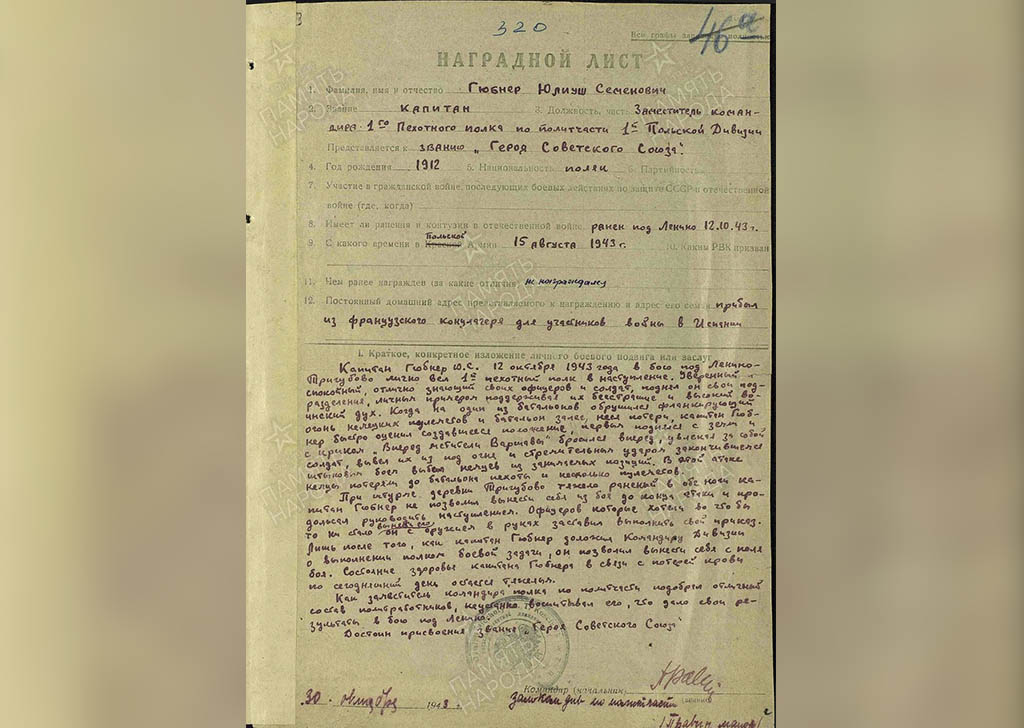
Hibner distinguished himself during the Battle of Lenino on October 12, 1943, when, at a critical moment in the battle, he replaced the deceased battalion commander and, despite two serious wounds, led the battalion. When he saw that Battalion Commander Lyakhovich was dead and the personnel were ready to retreat, Juliusz decided to inspire his colleagues with a personal example. The captain led the soldiers, but soon received two wounds in the leg one after the other. And despite this, Hibner stood up every time and led the fighters into battle. His colleagues wanted to take the captain off the battlefield, but Hibner wouldn’t let them. Juliusz managed to reach the height that the Poles had occupied. They were able not only to capture it, but also to hold it, withstanding a powerful German counterattack. Hibner was mistakenly considered dead (at that time the paramedics took him to the hospital) and was posthumously presented with the title of Hero of the Soviet Union. By decree of the Presidium of the Supreme Soviet of the USSR dated November 11, 1943, he was awarded the title Hero of the Soviet Union with the award of the Order of Lenin. After recovering, he was promoted to the rank of lieutenant colonel and was appointed commander of a regiment of the 2nd Polish Army.
On March 11, 1944, he was wounded again and sent to the hospital. After recovering, on May 1, 1944, Hibner entered the Frunze Military Academy in Moscow. He was then appointed deputy commander of the 37th Infantry Regiment, and later commander of the 32nd Infantry Regiment of the 8th Infantry Division of the 2nd Army. At this time, he participated in the Battle of Bautzen. During the battle near the village of Malkovitz, he was wounded for the third time.
After the war, he continued to serve in the Polish army and the State Security Service.
In 1948-1953, he commanded the Internal Security Corps.
Since 1958, he has been a major General.
He has been retired since 1966.
He defended his doctoral thesis and taught physics at the University of the Polish city of Lodz, the author of scientific papers and monographs.
He has awards: The Order of the Grunwald Cross, III degree.,
The medal “For Warsaw 1939-1945”, the Medal “For Odra, Nisa and the Baltic”, the Partisan Cross, the Bronze Medal “Armed Forces in the Service of the Motherland”, the Officer’s and Knight’s Cross of the Order of Virtuti Militari.