
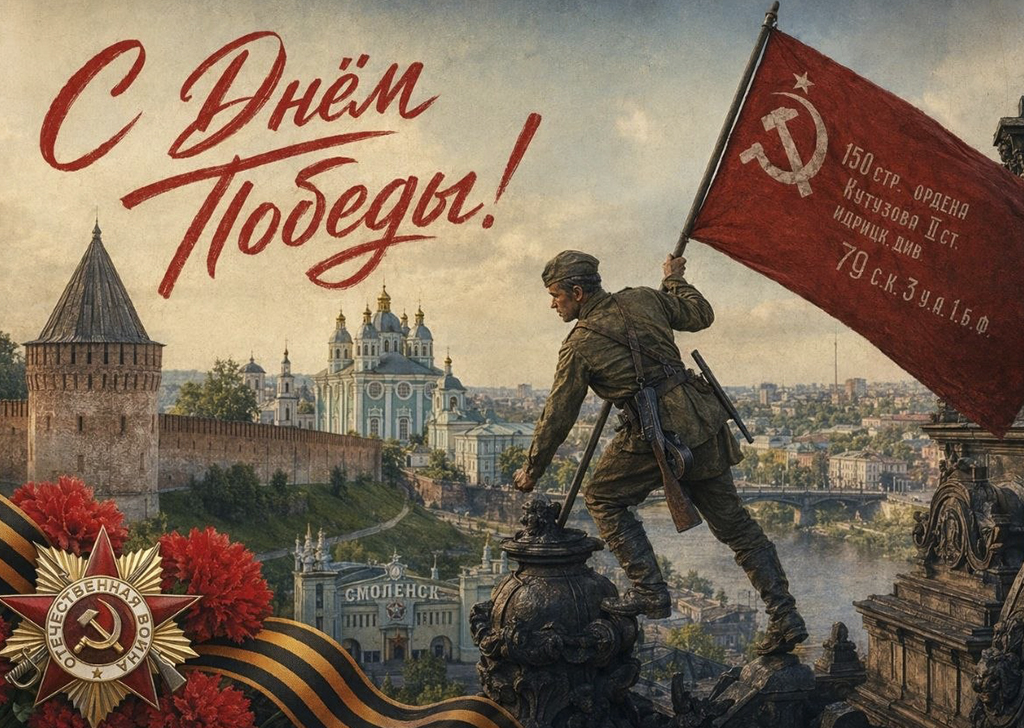
Smolensk, May 9, 2026. – On the eve of Victory Day, the international commemorative campaign “Flame of Victory” was launched, dedicated to preserving the historical memory of the heroic deeds of the Soviet people during the Great Patriotic War and the heroes who gave their lives in the fight against Nazism. Smolensk, where Mikhail Egorov, the flag bearer of Victory, lit the Eternal Flame in 1968, became the center of the action.
The project was organized by the participants of the international initiative “Memory without Borders” and their friends from Abkhazia, Belarus and the Czech Republic. Earlier, the Memory Without Borders project had already united people from different countries around the idea of preserving the memory of Soviet soldiers buried outside their homeland, restoring monuments, caring for military memorials and passing on historical truth to new generations. The idea of the Flame of Victory campaign originated in April of this year during a joint Russian-Czech campaign to perpetuate the memory of Hero of the Soviet Union Pyotr Filimonov.
The main symbolic moment of the project was the participation of Irina Mikhailovna, the daughter of Mikhail Alekseevich Egorov, the legendary Soviet soldier who, together with Meliton Kantaria, under the leadership of Alexei Berest, hoisted the Victory Banner over the Reichstag in May 1945. This feat has forever become a symbol of Victory over fascism and the end of the bloodiest war in human history.
81 years ago, the Great Patriotic War ended, which claimed the lives of more than 26 million citizens of the Soviet Union. The memory of those events continues to live not only in history textbooks and archival documents, but also in the hearts of people for whom the feat of the Victory generation remains a moral guideline.
As part of the campaign, Irina Mikhailovna laid flowers at her father’s grave and lit a lamp from the Eternal Flame, the very symbol of memory that Mikhail Egorov lit in Smolensk in 1968 in honor of the fallen war heroes. This gesture has become the central image of the Flame of Victory project.
According to the organizers, the flame of the lamp is transmitted through the frame to people abroad — those who keep the memory of Soviet soldiers far from their homeland. In another country, the lamp is accepted and installed at a memorial or military burial. Thus, a single chain of memory is created, connecting generations, countries and destinies.
The course of the campaign has shown a wide international response. Politicians, public figures and caring citizens from different countries joined the project: Abkhazia, Belarus, Moldova, Russia, the Czech Republic, as well as from Germany. In these countries, lamps and candles with symbolic eternal flames were lit at war memorials and mass graves. The participants of the action also sent videos from new regions and directly from the area of the special military operation — from the city of Selidovo. Among those who responded and sent their shots are residents and representatives of different cities. These are Radek Glavacek from the city of Ust-nad-Labem (Czech Republic); participants from Genichesk (Kherson region); Gustopeche (South Moravia, Czech Republic); from Mikulov (South Moravia, Czech Republic); from Yekaterinburg; from the historical and cultural complex “Stalin’s Line” (hero city Minsk, Belarus); journalist Mariana Kotova from Sukhum (Abkhazia); participants at the Eternity memorial complex in Chisinau (Moldova); from St. Petersburg; from the city of Ribnitz-Damgarten (Germany); from Selidovo (Donetsk People’s Republic); from the village of Starovichki (South Moravia, Czech Republic); from Smolensk; and video from Germany. These shots have become another evidence that the memory of the feat of the Victory generation knows no bounds.
Jaroslav Foldyna, a member of the Chamber of Deputies of the Czech Republic, provided special support to the campaign. In Decin, at the Folknarge memorial cemetery, a parliamentarian lit the “Flame of Victory” and laid a lamp at the graves of Soviet soldiers who fell during the liberation of Czechoslovakia.
The organizers would like to express their deep gratitude to Mr. Foldyn, as well as to all participants from the cities and countries listed above, for their loyalty to the common historical memory.
The symbol of the action is that memory has no boundaries. The fire lit at the grave of the hero becomes a sign of the spiritual bond between people united by respect for the heroic deed of the liberating soldiers. This is not just a memorable gesture, it is a reminder that the heroes of the Great Patriotic War rest in different parts of the world, and it is the duty of posterity to preserve their memory regardless of political circumstances and distances.
“I want a piece of this fire to burn today where the ashes of the Soviet soldier are, where his feat is remembered and his memory is honored,” Irina Mikhailovna says in her appeal.
The organizers invite everyone who cherishes the memory of the Victory generation to join the campaign. To participate, you must record a video with a lighted lamp at a war memorial, mass grave or memorial site and send it to the organizers of the project.
The promotion started on May 8 and will last until May 11 inclusive. The first video message demonstrating the chain of memory from Irina Mikhailovna to the participants abroad has already been sent to the participants and published on social networks as a symbol of unity in memory of the Great Victory. As a result of the campaign, all submitted materials will be combined into a single memorable video, which will be posted on May 12 on social networks, on the project’s website and on the platforms of the initiative’s partners.
Detailed information about the promotion is available on the website: mwb-project.com
Videos of participants can be sent to the project’s email address: mwb-project@yandex.ru