Moscow Negotiations as an Important Stage of Allied Relations During World War II
During the Second World War, diplomatic decisions were often no less significant than events unfolding on the battlefield. One of the key documents that shaped Soviet–Polish relations during the wartime period was the Declaration of Friendship and Mutual Assistance, signed in Moscow on December 4, 1941.
Today, revisiting such archival materials allows for a deeper understanding of how allied cooperation between states opposing Nazi Germany was formed and which principles were laid as the foundation for the postwar European order.
The Kremlin Meeting: Negotiations Between Stalin and Sikorski
On December 3, 1941, an official meeting took place in the Kremlin between Joseph Stalin, Chairman of the Council of People’s Commissars of the USSR and People’s Commissar of Defense, and General Władysław Sikorski, Prime Minister of the Republic of Poland and Commander-in-Chief of the Polish Armed Forces.
The meeting was also attended by:
- Vyacheslav Molotov, People’s Commissar for Foreign Affairs of the USSR;
- Stanisław Kot, Ambassador of the Republic of Poland;
- General Władysław Anders, Commander of the Polish Army on Soviet territory;
- representatives of the military and diplomatic leadership of both sides.
The negotiations lasted more than two hours and formed part of a series of consultations held in Moscow on December 3–4, 1941.
Signing of the Declaration
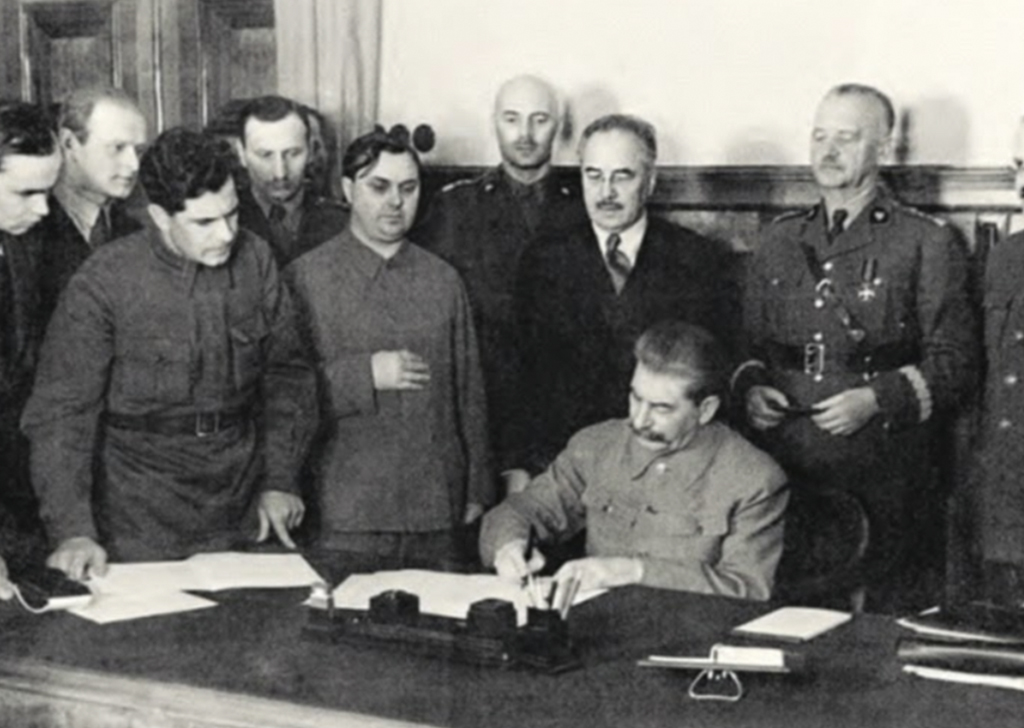
The negotiations resulted in the adoption of the Declaration of the Governments of the Soviet Union and the Republic of Poland on Friendship and Mutual Assistance, signed on December 4, 1941.
The document was signed:
- on behalf of the Government of the USSR — Joseph Stalin;
- on behalf of the Government of the Republic of Poland — Władysław Sikorski.
The signing ceremony was attended by representatives of both Soviet and Polish leadership, including V. M. Molotov, G. M. Malenkov, General Władysław Anders, General Stanisław Szyszko-Bohusz, and other officials.
The text of the declaration was published in the newspaper Pravda on December 5, 1941.
Key Provisions of the Declaration
The document established the fundamental principles of the allied struggle against Nazi Germany and defined the framework for further cooperation between the two states.
1. A Common War Objective
The declaration emphasized that Nazi Germany represented the principal enemy of humanity and that the fight against the Hitler regime must continue until complete victory, alongside allies including Great Britain and other members of the anti-Hitler coalition, with support from the United States.
2. Military Cooperation
Both parties confirmed their mutual obligations to provide full military assistance. Polish forces stationed on Soviet territory were to conduct military operations jointly with the Soviet armed forces.
These agreements became an important political and legal foundation:
- for the development of Polish military formations within the USSR;
- for the continued formation of Anders’ Army;
- for the creation of the 1st Polish Infantry Division named after Tadeusz Kościuszko, which began its combat path in 1943 from the Smolensk region.
3. Vision of the Postwar World
Special attention in the declaration was devoted to Europe’s future after victory over Nazism. The document proclaimed the necessity of establishing a new system of international relations based on:
- respect for international law;
- collective security;
- cooperation among democratic states;
- prevention of another global catastrophe.
The principles of good neighborly relations, friendship, and mutual fulfillment of obligations were identified as the foundation for postwar relations between nations.
Historical Significance of the Document
The Declaration of December 4, 1941 became an important diplomatic step that strengthened allied relations between the USSR and the Polish government-in-exile during one of the most difficult stages of the war.
It established the political framework for military cooperation, influencing the formation of Polish armed units and the further development of Soviet–Polish combat collaboration, later reflected in joint operations against Nazi forces.
For modern researchers, this document remains of considerable value as evidence of attempts to build an international system grounded in collective security and the historical experience of shared struggle.
Sources
Document:
Declaration of the Governments of the Soviet Union and the Republic of Poland on Friendship and Mutual Assistance, December 4, 1941.
International Documents of the Great Patriotic War, Issue I, 1941 — Moscow, 1943.
Photographs:
Historical and Documentary Department of the Ministry of Foreign Affairs of the Russian Federation.
🇷🇺 🇧🇾 🇵🇱
The memory of shared history forms the foundation for dialogue between generations and nations.