
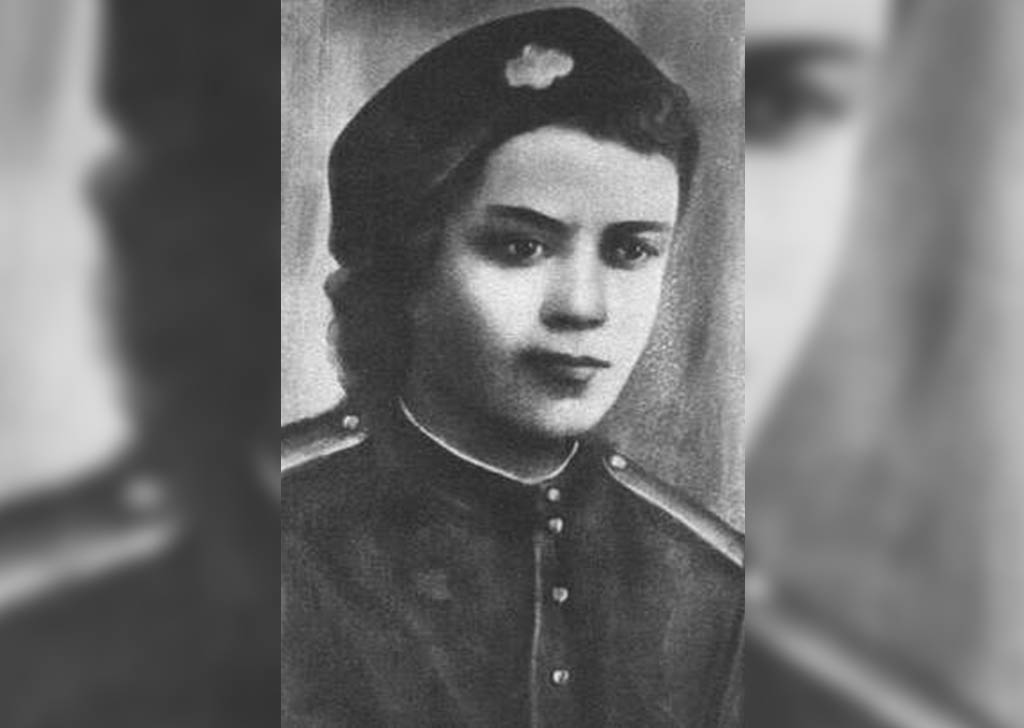
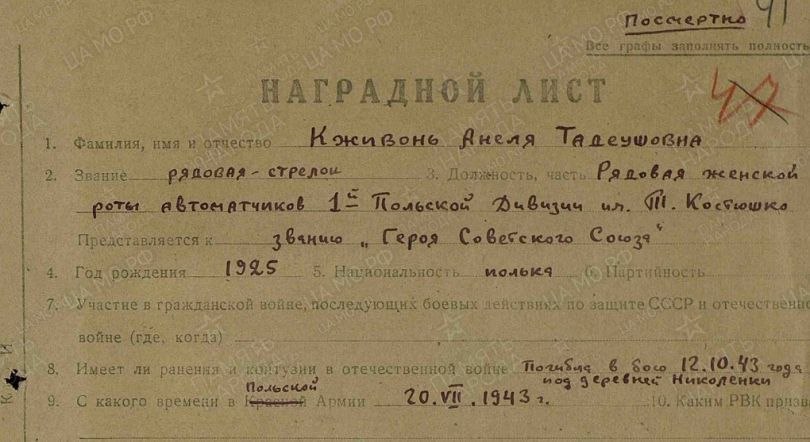
Anelya Tadeushovna Kzhivon (May 27, 1925, Puzhniki farm, Tarnopol Voivodeship, Poland — October 12, 1943, Lenino, Mogilev region) was a female submachine gunner in the Tadeusz Kosciuszko division of the Polish Army, a private.
She was born in the family of a siege engineer. Aneli’s father served in Pilsudski’s legions, then participated in the Soviet-Polish War of 1919-1920.
In early 1940, Aneli Kzywon’s family, along with other Polish families, was deported first to the village of Yakutino in the Shitkinsky district of the Irkutsk Region, then transferred to the city of Kansk in the Krasnoyarsk Territory.
In the city of Kansk, Krasnoyarsk Territory, Anelya worked at a woodworking plant. Together with her exiled compatriots, she dreamed of fighting for the liberation of her native Poland from the Nazis. In May 1943, after learning about the formation of the Polish Division. Tadeusz Kosciuszko, signed up as a volunteer. She was enrolled in a company of submachine gunners of the 1st separate women’s battalion. She served as a rifleman in the women’s company of submachine gunners of the Emilia Plater Women’s Infantry Battalion of the Tadeusz Kosciuszko 1st Polish Infantry Division as part of the 33rd Army of the Western Front.
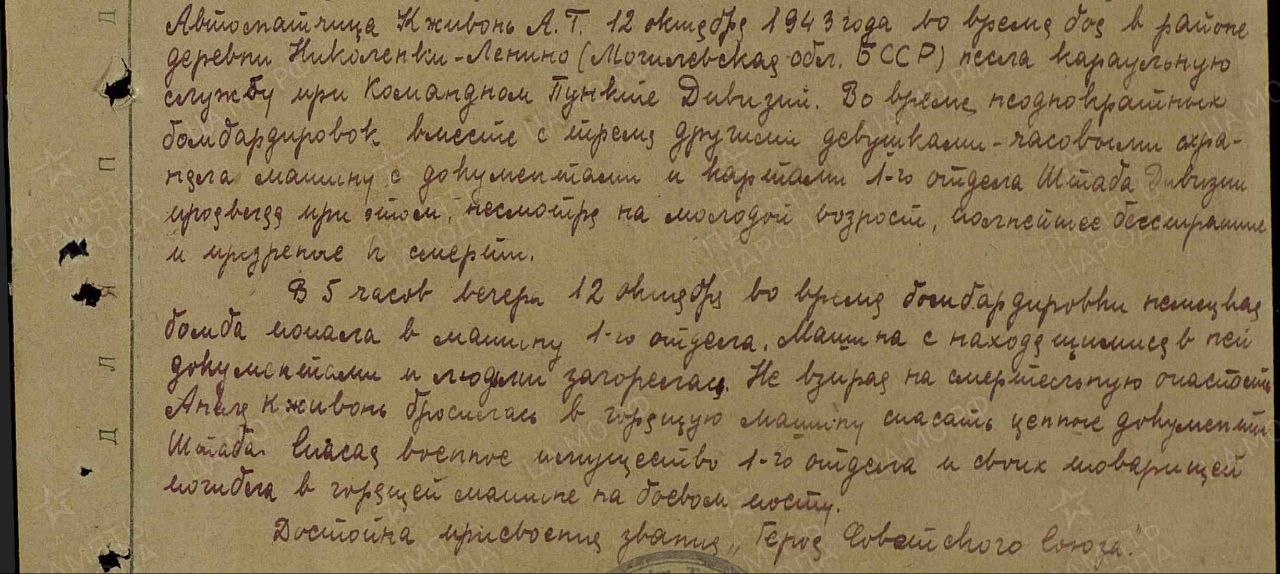
On October 12, 1943, the 1st Polish Division fought its first battle near the village of Lenino in the Goretsky district of the Mogilev region of the Byelorussian SSR. On the same day, Aniela Kzhivon was on guard duty at the divisional command post near the villages of Nikolenka-Lenino, Mogilev region. During the repeated bombings, she and three other sentry girls guarded a car with documents and maps from one of the divisions of the division headquarters. At 5 p.m. on October 12, during the bombing, a German bomb hit a car. The car with the documents and people in it caught fire. Despite the mortal danger, Aniela Kzhivon rushed into a burning car to rescue the wounded, valuable headquarters documents and military equipment. She died in a burning car at a combat post.
By decree of the Presidium of the Supreme Soviet of the USSR dated November 11, 1943, Anela Kzhivon was awarded the title Hero of the Soviet Union (posthumously) for her exemplary performance of combat missions of the command at the front of the struggle against the German invaders and her bravery and heroism.
She was buried at the Polish military cemetery in Lenino (Mogilev region). She was also posthumously awarded the Order of Lenin and the Polish Order of Virtuti Militari V class.
In Poland, streets in the cities of Warsaw, Bielsko-Biala, Zabrze, Zielona Gura, Krakow, Lodz, Nowa Demba and Skierniewice are named after her.
Busts of Aniela Kzhivon have been installed in Ukraine (in the village of Koropets and the village of Sadovoye, Monastyrysk district, Ternopil region).
In Belarus, in the village of Lenino in the Goretsky district of the Mogilev region, a Museum of the Soviet-Polish military alliance has been opened, which describes the feat of Aneli Kzhivon.
In Kansk, Krasnoyarsk Territory, a monumental sculpture of Anele Tadeushevna Kzhivon has been installed on the territory of the administrative building of a Timber processing plant.
Aneli Kzhivon’s memory is also immortalized in the village of Nikolaevka, Krasninsky municipal District, Smolensk region.