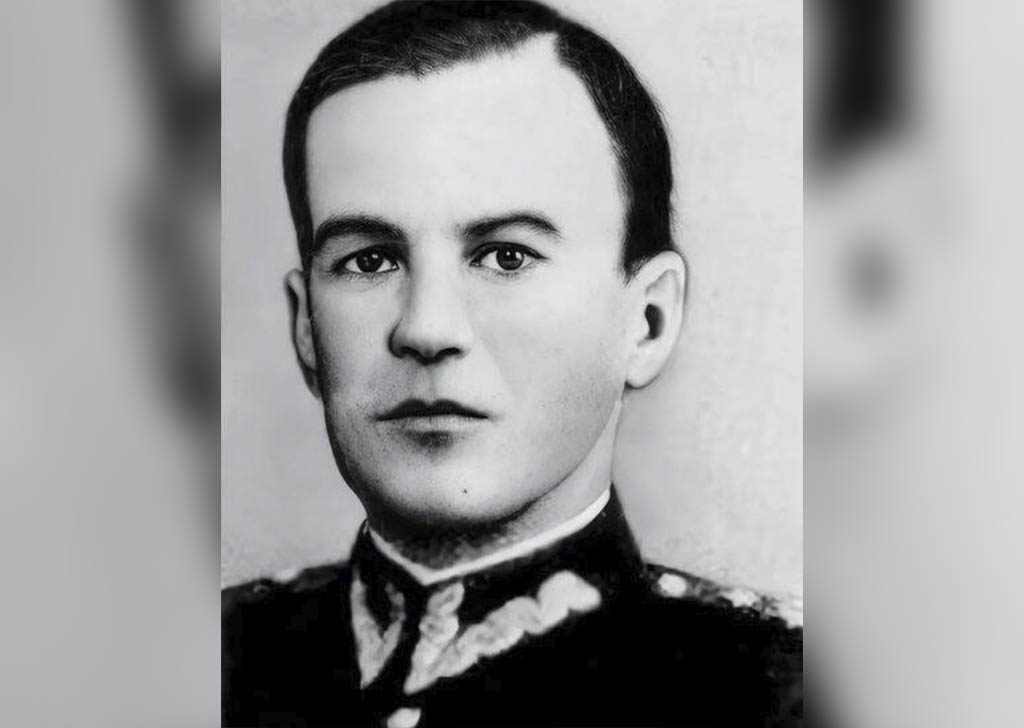
Vladislav Kazimirovich Vysotsky. Captain, Deputy commander of the 3rd Battalion of the 1st Infantry Regiment of the 1st Polish Division named after Tadeusz Kosciuszko.
He was born on April 24, 1908 in the city of Bielsk-Podlaski, Grodno province of the Russian Empire. A Pole from a noble family. He graduated from the gymnasium in Bielsk and studied at the cadet school, became an officer of the Polish Armed Forces. Since 1936, he served in the Polish 77th Infantry Regiment in the city of Lida (Poland). During the 1939 German-Polish War, he fought in the ranks of the 77th Infantry Regiment. After the end of the fighting, he returned to Bielsk Podlaski. In December 1939, he was arrested by the Soviet authorities and placed in an internment camp.
When the formation of the Tadeusz Kosciuszko 1st Polish Infantry Division began under the command of General Zygmunt Berling, he was released and enlisted in this military formation.
On October 12, 1943, the commander of the 3rd battalion of the 1st Infantry Regiment, Captain Vladislav Vysotsky and his men successfully captured a powerful enemy resistance node and captured the first line of defense of the Nazis, wedging into the second. At a critical moment in the battle, being wounded, he led his soldiers into a bayonet charge. Captain Vysotsky died a brave death in this battle. The place of death is near Tregubovo village, Goretsky district, Mogilev region, Byelorussian SSR.
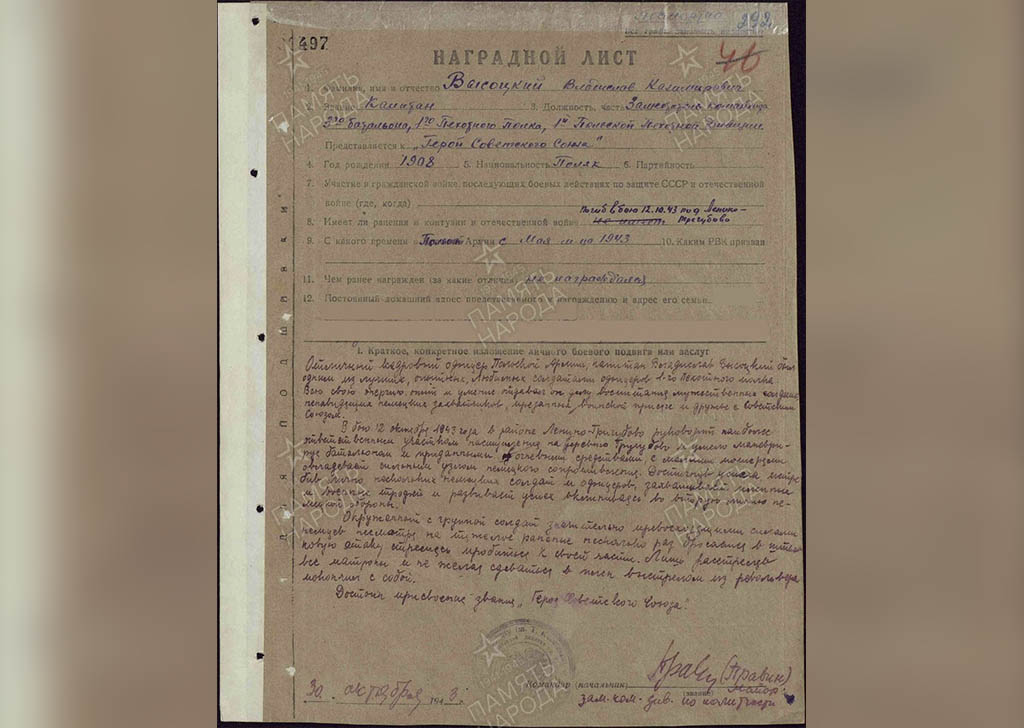
From the award list: “An excellent career officer of the Polish army, Captain Vladislav Vysotsky was one of the best, most experienced, and beloved officers of the 1st Infantry Regiment. In the battle of October 12, 1943, in the Lenino-Trigubovo area, he led the most responsible section of the offensive from the village of Tregubovo and, skillfully maneuvering the battalion and the attached firepower, captured a strong node of German resistance with few losses. Having achieved success, he personally killed several soldiers and officers, captures prisoners and war trophies and develops success by wedging into the second line of German defense. Surrounded by a group of soldiers with significantly superior German forces, despite being seriously wounded, he rushed into a bayonet attack several times, trying to break through to his unit. Only after firing all the cartridges and not wanting to surrender, he committed suicide with a shot from a revolver.”
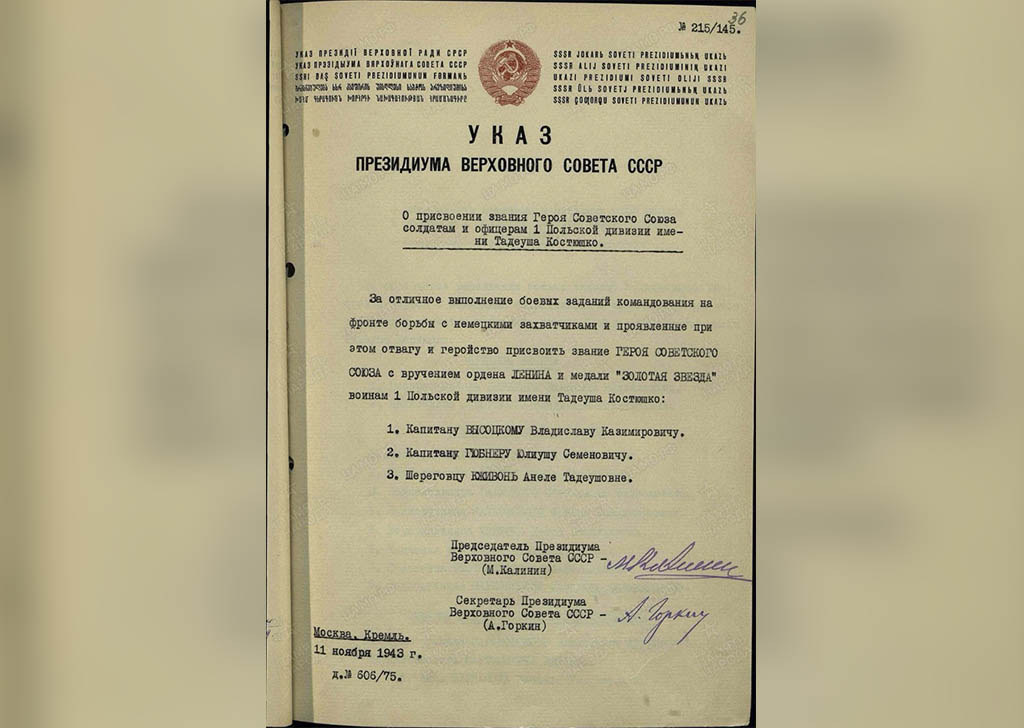
By decree of the Presidium of the Supreme Soviet of the USSR dated November 11, 1943, Captain Vysotsky Vladislav Kazimirovich was posthumously awarded the title Hero of the Soviet Union for exemplary performance of combat missions of the command at the front of the struggle against the German invaders and his bravery and heroism.
In 1968, the remains of Vladislav Vysotsky were reburied at the Polish Military Cemetery, at the place where the division launched its offensive against the Germans. A wall of gray granite with a dedication inscription in Polish and Belarusian was erected on the mass grave.
Vladislav Vysotsky was awarded the Order of Lenin (posthumously), as well as the Silver Cross of the Order of Virtuti Militari (“Military Valor”). Of the Polish People’s Republic (posthumously).
A commemorative bust has been erected in honor of Vladislav Kazimirovich Vysotsky in the city of Bielsk Podlaski (Poland).
The name of Captain Vysotsky was given to primary school No. 2 in the city of Bielsk Podlaski (Poland). The street where the school is located is also named after Hero of the Soviet Union Vladislav Kazimirovich Vysotsky.
On October 4, 1973, the Polish Minister of National Defense, General Wojciech Jaruzelski, named a mechanized regiment in Wesole after Vysotsky.
At the museum of the memorial complex in the village of Lenino (Goretsky district) Vysotsky’s name is listed on the walls among the names of other fallen soldiers. There you can also see the certificate of the Hero of the Soviet Union and a commemorative medal issued in honor of Vysotsky.